
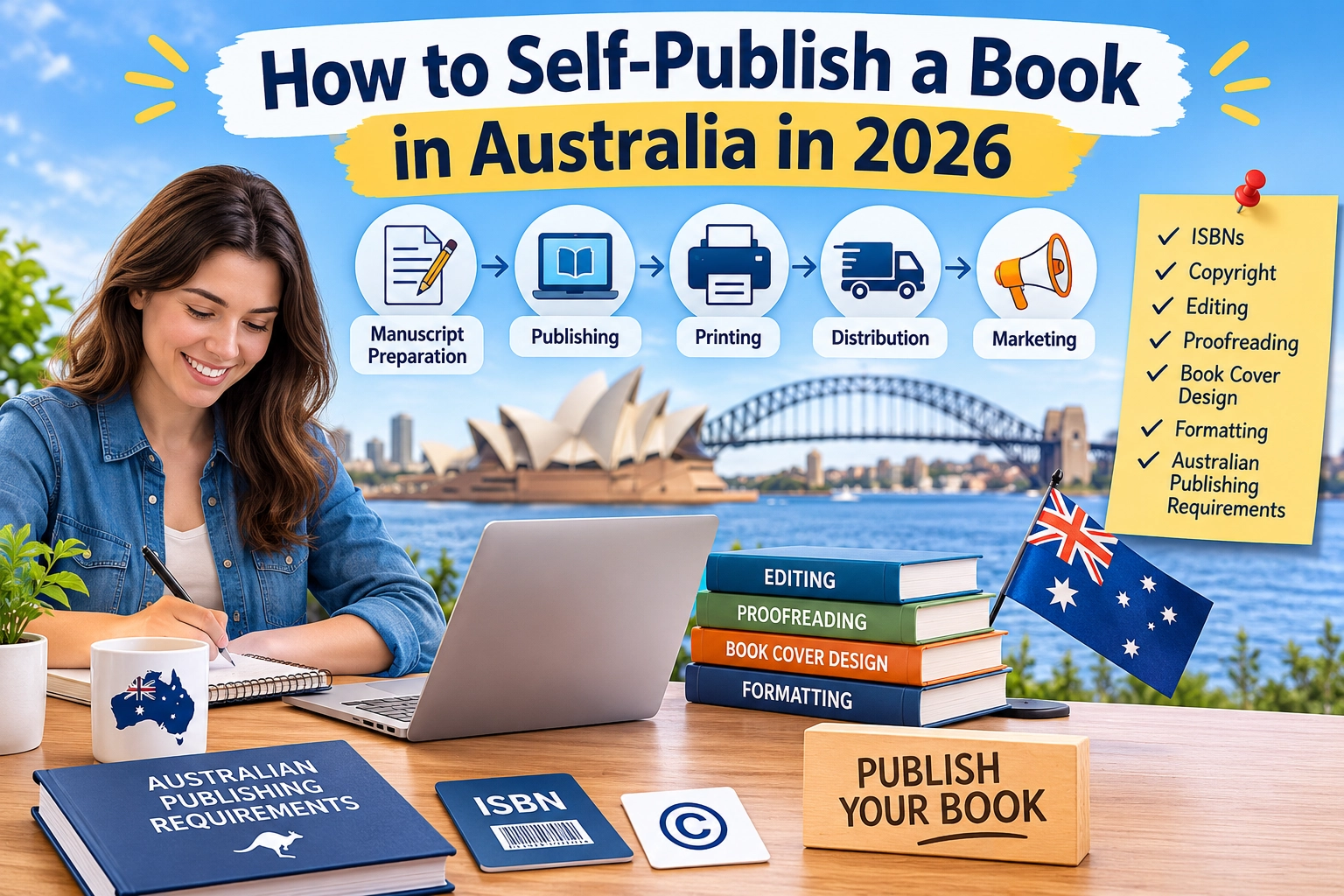
How To Self Publish Your Book in Australia? Step by Step Guide
We all have once dreamt of writing a book and seeing it on a bookstore shelf, haven’t we? Maybe you have completed your first novel, and now you can’t wait to share it with your potential readers. Whatever your publishing goals may be, turning your manuscript into a professionally published book is definitely an exciting achievement.
You just have to pick a publishing path. Most authors often go with self publishing for more creative control.
But are you aware of the self publishing process? No worries, we’re here to guide you!
Let’s understand how you can successfully publish your book in Australia in 2026.
Which Publishing Path Should You Choose?
We’ll begin our guide by discussing which publishing path you should choose.
Before preparing your book for publication, you need to understand the two main publishing routes. Each offers different levels of creative freedom, financial responsibility and professional support.
Traditional Publishing
Traditional publishing basically involves submitting your manuscript to an established publishing house.
If the publisher accepts your work, it generally manages not only editing and book production but also printing, distribution and marketing.
The publisher usually covers the production expenses. However, you must keep in mind that the competition for publishing contracts can be high. Plus, authors have less control over certain creative and commercial decisions.
You may not know this, but traditional publishing can take a lot of time.
Self Publishing
Besides that, self-publishing in Australia allows authors to manage the publication process themselves or hire professionals to handle individual stages. You retain greater control over not only your manuscript and cover design but also your publishing schedule and pricing.
You also have to invest in the services your book requires.
Why Are More Australian Authors Opting for Self Publishing?
Australian authors are commonly choosing self publishing because it offers higher financial royalties. In addition to this, it offers full creative control and much faster release timelines compared to traditional publishing.
On top of that, you have direct rights and ownership.
Higher Financial Royalties
You may not know this, but traditional publishers usually pay authors an agreed royalty based on their publishing contracts.
However, independent authors can receive a larger share of the revenue from each sale. And this share is after applicable printing, distribution and platform charges.
This makes self-publishing a book in Australia a wise choice for writers who want to manage their own publishing income.
Full Creative Control
What if you spend months writing a book only to discover that someone else wants to change its title, cover or presentation? It would be frustrating, right?
But this isn’t an issue for self-published authors.
This is because self-publishing gives you greater control over these decisions. You can select not only the book’s appearance and interior layout but also illustrations, publishing format and final pricing while ensuring the finished product reflects your original vision.
Faster Time to Market
Besides that, traditional publishing involves submission reviews, contract negotiations and production schedules. These stages can significantly extend the publication timeline.
Independent authors, on the other hand, can establish their own schedules and move towards publication once their manuscript and production materials are ready.
Direct Rights and Ownership
Self-publishing generally allows authors to retain their copyright and publishing rights unless they agree otherwise in a separate contract.
This provides greater flexibility when you have to explore future editions, audiobooks, translations, adaptations and international publishing opportunities.
However, you must always review the terms of any distribution or publishing agreement before signing.
How Can You Self Publish a Book in Australia? Steps
Now comes the main part that is self publishing a book. So, how do you do that?
You need to begin by preparing and editing your manuscript. Besides that, you should not only format your book design and book cover but also get an ISBN and print it.
Don’t forget to distribute and market your book.
Prepare Your Manuscript
You must also know that your manuscript is the foundation of your book. Before considering publication, you need to make sure that the content is complete and logically organised. In addition to this, it should be suitable for your intended readers.
You have to start by reviewing the overall structure. Also, check whether the chapters follow a logical sequence, the arguments are clear and the story maintains consistency.
Edit and Format It
Once you have completed your manuscript, you need to consider professional editing. Depending on your manuscript’s condition, you may need.
❖ Developmental editing
It allows you to improve the overall structure, storytelling, character development and flow.
❖ Copyediting
Copyediting helps authors correct not only grammar and sentence structure but also punctuation and consistency.
❖ Proofreading
Proofreading, on the other hand, identifies remaining spelling, formatting and typographical errors before publication.
However, you shouldn’t confuse editing with proofreading. Both serve different purposes, and skipping either can affect the quality of your finished book.
Besides that, interior formatting is equally important. You must choose not only readable fonts and consistent margins but also appropriate line spacing and well-organised chapter headings.
If you want to release both digital and printed editions, then remember that ebook formatting and print formatting require different file specifications.
Design a Book Cover
We all know that a book cover creates the first impression. This is why your book cover should communicate the subject, genre and intended readership while staying visually appealing.
Besides that, you can also consider hiring a professional designer who understands the standards of self-publishing in Melbourne Australia.
On top of that, your cover should include not only an appropriate title and author name but also other relevant information. Printed books may also require a spine and a barcode on the back cover.
Get an ISBN
Besides that, you have to get an ISBN. But what is it? Well, an International Standard Book Number (ISBN) is a unique identifier that helps not only retailers and libraries but also distributors and booksellers recognise your publication.
You may not know this, but Thorpe-Bowker is the official ISBN agency in Australia. Authors can purchase ISBNs through its MyIdentifiers website.
However, you need to keep in mind that an ISBN is not legally mandatory for every publication. But it is generally important for commercial book distribution and retail discoverability.
Remember that
- Each book format requires its own ISBN.
- A paperback and hardcover need separate ISBNs.
- A revised edition may require a new ISBN.
- An ISBN does not provide copyright protection.
Print Your Book
You have to print books only when customers place orders. This reduces upfront printing expenses. Besides that, you don’t even have to store large quantities of stock.
Self publishers in Australia generally have two options.
❖ Print-on-Demand
You have to print books only when customers place orders. This reduces upfront printing expenses. Besides that, you don’t even have to store large quantities of stock.
❖ Bulk Printing
You need to order a specific number of copies in advance. This can reduce the cost per copy but requires a larger initial investment and storage arrangements.
Besides that, you should consider not only your book’s page count and paper quality but also binding and colour requirements before requesting printing quotations.
For self-publishing book printing in Australia, you must compare Australian printers and overseas manufacturing options. However, you should always order a physical proof before approving a full print run.
Distribute and Market Your Book
Many authors don’t realise that publishing your book is only half the journey. Readers must also be able to discover and purchase it.
You can distribute your publication not only through online retailers and independent bookstores but also through libraries, your own website and relevant literary events.
Apart from that, you have to create a marketing strategy before launch. You can also consider building an author website, sharing excerpts on social media, contacting book reviewers and collecting advance reader feedback.
You can also organise book launches and participate in local literary festivals. Also, connect with reading communities.
Remember that a consistent marketing strategy can help you build awareness and give your publication a better chance of reaching its intended audience.
What Are the Australian Publishing Requirements? A Checklist
But the question is, how will you know whether your manuscript meets Australian publishing requirements? You can use this checklist!
Copyright Ownership
You may not know this, but copyright protection generally arises when an original literary work is created and recorded in material form. And no, Australia doesn’t really have a general copyright registration system.
ISBN Registration
You can obtain an ISBN if required by your chosen retail or distribution channels. Thorpe-Bowker is Australia’s official ISBN agency.
Publication Details
Besides that, you need to prepare accurate publication information. This includes not only the title and author name but also the publisher or imprint and publication date.
Legal Deposit
Australian publications are generally subject to legal deposit requirements under the Copyright Act 1968.
This means that Authors publishing independently should submit the required copies to the National Library of Australia and their relevant state or territory library. Authors can deposit electronic publications through National eDeposit (NED).
Third-Party Permissions
In addition to this, you have to take permission to reproduce copyrighted photographs, illustrations, quotations or other protected material where required.
Print Specifications
You must also ensure that your final files meet the printer’s requirements for dimensions, bleed, margins, resolution and binding.
Distribution Agreements
Last but not least, you need to understand not only the rights and exclusivity conditions but also the payment arrangements and royalty deductions associated with your chosen platform.
What Are the Different Self Publishing Options Available to Australian Authors?
Now that you have decided to self-publish a book in Australia, you need to be familiar with the different self publishing options.
Amazon Kindle Direct Publishing (KDP)
Amazon Kindle Direct Publishing (KDP) is one of the most accessible platforms for independent authors.
It basically allows you to publish ebooks and paperback books without paying an upfront platform publishing fee. Its print-on-demand service produces physical copies when readers place orders.
KDP offers access to Amazon marketplaces for authors considering Amazon self-publishing in Australia. However, you must keep in mind that printing costs and distribution deductions affect your final royalty.
You can also use a free KDP ISBN for eligible paperback and hardcover editions. However, this ISBN is restricted to KDP, so purchasing your own ISBN is often better if you want greater publishing flexibility.
Independent Publishing Platforms
Independent publishing platforms offer authors different combinations of book production, distribution and publishing support.
Some focus primarily on ebook distribution, while others offer print-on-demand and connections to international book retailers.
Before uploading your manuscript, you need to research not only the platform’s distribution network and payment arrangements but also its file requirements and author rights.
Professional Publishing Services
If you want expert assistance without managing every production stage yourself, then professional publishing providers can help.
A reliable self publisher in Australia can handle not only editing and cover design but also formatting, ISBN arrangements, printing and distribution.
This option can be quite useful for first-time authors who are unfamiliar with publishing requirements.
Hybrid and Author-Funded Publishing
Besides that, you can also consider hybrid and author-funded publishing. But what does it even mean? Well, this arrangement combines professional publishing support with author investment.
However, you must keep in mind that these models differ. Some hybrid publishers share production expenses and revenue. On the other hand, author-funded service providers charge authors for specific services.
Before choosing this route, you must investigate not only the company’s reputation and contractual terms but also ownership arrangements and real distribution capabilities.
What Is the Cost of Self Publishing in Australia?
Self-publishing a book in Australia typically costs between $2,000 and $15,000 AUD.
However, you must keep in mind that the publishing costs depend not only on your manuscript’s length and editing requirements but also on your book format, design complexity, printing method and marketing strategy.
A professionally produced book generally requires a larger investment than a basic DIY publication.
This table will help you get an idea of the estimated budget required for self publishing in Australia.
| Publishing Stage | Approximate Timeline |
| Manuscript Assessment | $300 – $1,200+ |
| Editing | $1,000 – $3,500+ |
| Proofreading | $400 – $800+ |
| Cover design | $300 – $1,500+ |
| Interior formatting | $150 – $750+ |
| ISBN | $44 |
| Printing | Depends on quantity and specifications |
| Marketing | $150 – $1,500+ |
These are just estimates rather than fixed industry rates. Professional editing and illustration can cost considerably more depending on the project.
You need to search for ‘Self Publish Book Pricing’ to get an idea of up-to-date rates near you.
How Long Does Self-Publishing Take?
Well, there is actually no universal publishing timeline. However, a useful planning estimate for an independently published book is around three to nine months.
| Publishing Stage | Approximate Timeline |
| Manuscript Preparation | 2-8 weeks |
| Editing and Proofreading | 3-8 weeks |
| Cover Design and Formatting | 2-5 weeks |
| ISBN and Platform Setup | 1-2 weeks |
| Proofing and Printing | 2-8 weeks |
| Launch Preparation | 2-4 weeks |
However, you should remember that these stages can overlap. Illustrated books and complex non-fiction publications may take considerably longer.
Is Seeking Self Publishing Services in Australia a Smart Choice for Authors?
However, many authors often seek self publishing services in Australia. But is that a wise decision?
Publishing independently doesn’t mean you must handle every task yourself. In fact, professional assistance can make the process pretty easy.
These experts can help authors transform unfinished manuscripts into professionally edited, designed and formatted books.
However, choosing a publishing provider requires careful research. You can search for ‘Best self-publishing companies in Australia’. But make sure that you don’t select a company simply because it offers an attractive package or promises bestseller status.
Instead, you need to evaluate a few factors. These factors include not only professional experience and transparent pricing but also editorial expertise and design quality. You must also ensure that the service provider guarantees distribution support and author ownership.
Professional Experience
You first have to ensure that the experts have proven experience in your specific genre. Also, review their publishing portfolio and previous projects. This will help you get an idea of their work.
If you’re working on a children’s book, then you must opt for a company that guides you through self-publishing children’s books in Australia.
Transparent Pricing
Besides that, you should request a detailed breakdown of included services and additional charges.
Editorial Expertise
You must also check whether the provider offers qualified editors and proofreaders.
Design Quality
In addition to this, you need to examine examples of their book covers and interior layouts. This will help you choose a provider who offers top-notch assistance.
Distribution Support
Ask which retailers, online platforms and distribution networks they can access.
Author Ownership
Finally, you have to confirm that you understand your copyright and publishing rights. When you are exploring self publishing packages, make sure that the provider guarantees author ownership.
FAQs
The Bottom Line!
Many Australian authors opt for self publishing. However, only a few succeed. This is mostly because a majority of authors aren’t even familiar with the self publishing process.
To do so, you have to first prepare your manuscript. Besides that, you must not only edit and format it but also design a book cover and get an ISBN. After that, print your book.
You must also distribute and promote your book.
On top of that, you need to ensure that you meet all Australian publishing requirements. This includes copyright ownership, ISBN registration, publication details, legal deposit, third-party permissions, print specifications and distribution agreements.
You can also consider seeking self publishing services in Australia. This makes the publishing process much easier, especially for first-time authors.

Maxien Liam works as a dedicated author for Australianpublishers, where he writes informative blogs covering publishing trends, writing techniques, and industry best practices. Maxien provides practical guidance on editing, design, printing, and distribution to help writers succeed. She helps both new and experienced authors create professional, market-ready books.