
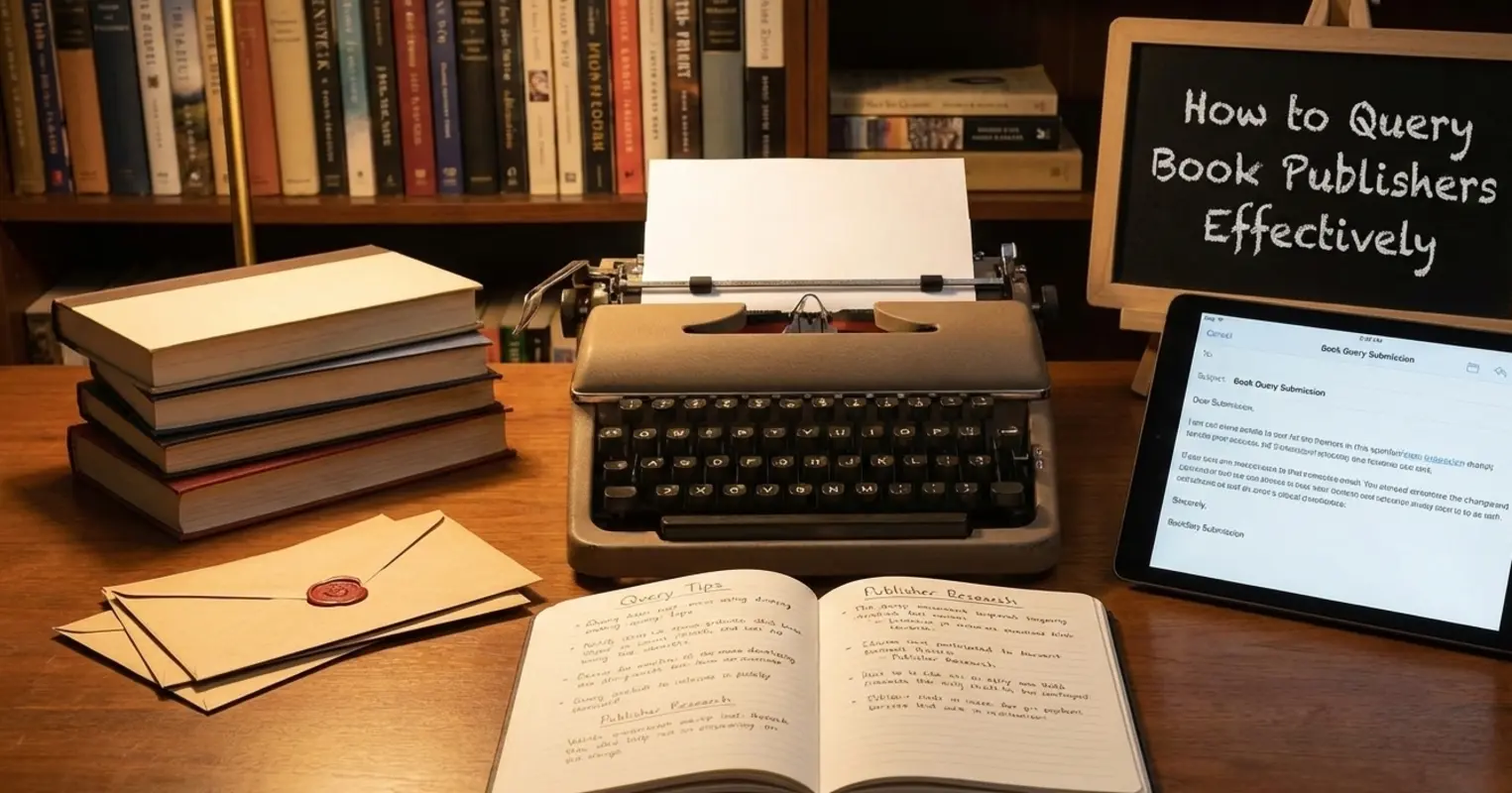
How to Query Book Publishers Effectively
Breaking into publishing isn’t about luck. You have to make your way through calculated moves that will win over the concerned official. In your case, a publisher. So, what is a query letter after all? Is it a thorough solution to the authors’ problems? Honestly, yes.
It is a writer’s first handshake with a publisher, and if it is limp, rushed, or generic, they are most likely to lose that chance before the conversation even begins.
This means that writers have been obsessing over the wrong thing. The manuscripts aren’t what will save them, but it is the well-written query letters that require the greatest amount of attention. Done right, it acts as your winning pitch. Make a mistake, and lose almost everything.
Let us learn more.
Sending Queries That Publishers Really Pay Attention To
Knowing how to pen down a query letter for your targeted publisher may not much like labour, but trust us, it is. Also, just by the way, it is also proof that you understand the business side of writing. It suddenly makes you more attractive in the eyes of the publishing company.
This guide strips away the fluff and shows you how to query book publishers effectively, blending professionalism with personality. As a result, you will be able to write your own letter, a perfect one that doesn’t end up in the trash and gets you a step closer to comic book printing.
Let’s Understand What a Query Letter Really Is
A query is NOT a summary of your book. It is rather a business proposal in disguise. You can take it as a document especially written for publishers who want to know two things:
- Is the manuscript marketable?
- Is the writer professional enough to work with?
This letter is also sort of a building bridge between you and the publishing house. It helps unite your creative world with the commercial reality on the other side. You just have to find a reliable one for yourself through research.
Research Before You Reach Out
Yes, that is 100% true. Sending a query blindly is like submitting a research paper to the wrong journal. Or applying for a job without reading the role description. Or mailing a product sample to a company that doesn’t sell in that category. Ask yourself this question:
Do I really want to take this big a risk with my book’s future?
You should think about that twice. After all, officials at eBook publishing services are experts, and they expect the author to know their focus. Here are 3 things that you need to focus on.
- Start by studying their catalogue
- Ask, what genres do they dominate?
- Ask, do they lean toward debut authors or established names?
- Next, check submission guidelines
- A few publishers want email queries, while others prefer online forms.
- You cannot ignore these rules, as that signals carelessness.
- In the end, note their tone and style
- A publisher of literary fiction expects a pitch unlike that of a fast-paced thriller.
- It is your job to figure out the required tone and style.
Begin with a Hook That Holds the Attention at Once
Your opening line is actually the difference between a skim and a read. So, avoid the tired ‘I am seeking representation for my novel…’ because the publishers see that hundreds of times a week. Instead, try to lead with something that speaks volumes about the book’s theme.
- For example:
‘In a city where memories can be bought and sold, one woman discovers the cost of forgetting.’
This isn’t a synopsis.
It is an intriguing hook.
It makes the reader want to know more.
You Need to Balance the Story and the Market
We stated this before, too: a query letter has two jobs.
- The author shows his story’s appeal.
- The author proves its commercial potential.
So, after your hook, it is best that you give the audience a tight summary of the book. Two or three paragraphs max. The entire focus will be on the protagonist, the central conflict, and the stakes. This is not the right time to drown in subplots.
Then, quickly move back to the market. In this part, you need to ask questions like:
- Who will read this book?
- What comparable titles prove there’s demand?
- How does your book stand out?
When you have the answers, you can rightly position your book in the eyes of the Book Publishers Australia. They must be able to see where your work fits on the shelf.
Next, You Need to Show Your Credentials Without Overstretching
By the word credential, we want to bring your attention to the awards you have won, the short stories you published, and the platform you built. If there is anything of that sort, you need to mention it. But don’t stuff your bio with irrelevant details.
For instance, saying that you ‘have loved writing since childhood’ adds nothing. In its place, you can just start highlighting achievements that matter. Such as:
- Publications in journals or magazines.
- Relevant professional expertise (a doctor writing a medical thriller, for instance).
- Social media following or newsletter audience.
In the end, make sure you keep it concise. Your credentials should reinforce your authority, not overshadow the book.
Respecting the Format is Inescapable
A query letter isn’t the place to reinvent the wheel. No matter what, you need to stick to professional formatting.
- Make sure it is just 1 page, single-spaced, and standard font.
- You must address the correct editor or submissions manager.
- Also, the subject line should be strong if you are sending it by email.
FAQS
What are the possible common pitfalls that you must avoid?
It is worth noticing that even strong manuscripts get rejected because of sloppy queries. So, it is important to make sure that there are no overwriting, desperation in the tone, generic pitches, and proofreading errors.
How does a publisher realise that I am faking flattery?
It is honestly no uphill battle to identify. Your generic phrases scream out loud how the query letter is just a publisher-buttering-trick in your understanding.
Can I write it just the night before submission?
Although you can, you should not. An author must never rush to query the exact moment they finish a draft. Similarly, doing it last minute is also not a wise move.
Final Thoughts
Querying effectively is about respect. An author uses it to earn respect for his work, for the publisher, and for the process. However, a strong query doesn’t guarantee acceptance. It only guarantees that you will be taken seriously.
This means you need to focus very hard on pitching your book. The person on the other side of the bridge in the commercial world can be a reader, a publishing house, an agent, or a media house. This should not worry you. Just follow the instructions above and confidently present yourself in the letter.

Maxien Liam works as a dedicated author for Australianpublishers.com.au, where he writes informative blogs covering publishing trends, writing techniques, and industry best practices. Maxien provides practical guidance on editing, design, printing, and distribution to help writers succeed. She helps both new and experienced authors create professional, market-ready books.